You’d be hard pressed to find someone who doesn’t have some kind of memory of the stage as a child: whether it was school performances or putting on plays for your parents at home in the garden, most of us had our taste of the spotlight once upon a time. It’s just that not all of us were willing to leave it.
So Molly Gordon beautifully showcases in the satirical, heartfelt extravaganza that is Theater Camp. With its glitz, glamour, industry inside jokes and willingness to go that extra step into madness, Gordon has proven indisputably that she’s not afraid of looking camp right in the eye.
The result? The indie comedy of the summer.
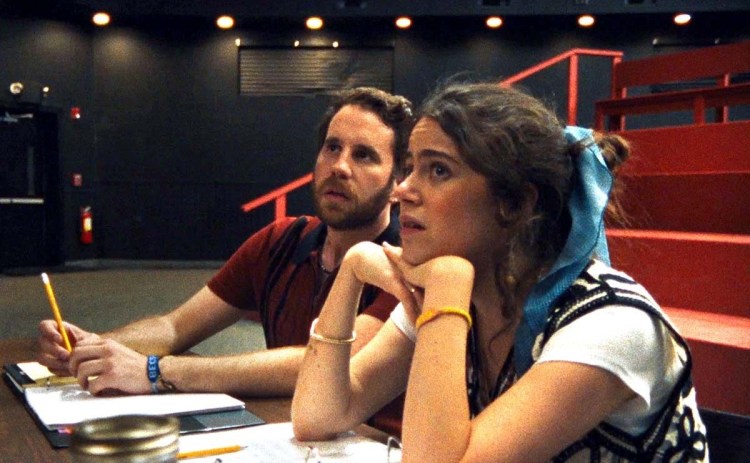
Adapted and expanded from the 2020 short film of the same name that was made by the same creative team; Theater Camp follows the staff and attendees of an American summer theatre camp trying to make things work as usual while their owner is in a coma and her clueless son takes over her duties.
The mockumentary is a heartfelt, eclectic and self-jesting film that shows the equal parts of madness and heart that go into theater: the kind of satire so pitch perfect it can only have been made by those who truly understand and adore the very thing they’re mocking. All the best satirical pieces of work come from a place of real love and care, which makes it all the more resonant with those who understand and identify with the larger-than-life characters.
Molly Gordon and Nick Lieberman direct, in Gordon’s directorial debut and Lieberman’s feature debut. The pair handle their material with relative ease, choosing to adopt a hyper-specific tone to carry their narrative, the mockumentary stylings taking care of a fair chunk of the technical elements on their behalf. With Gordon also starring in, writing, and producing the film, it’d be interesting to know their process as a directorial duo. Whatever they did worked as they cultivated a quirky, energetic atmosphere throughout the film and squeezed a lot of great performances from their talented cast that feel male for many moments that feel like lightning in a bottle.
Molly Gordon’s wild head of music Rebecca-Diane steals every scene. Gordon throws herself into the ridiculous and gives us everything from hilarious past life assignments to full on snot bubbles, shining most in her mad interactions with students and her more earnest moments with Amos. Molly Gordon has long since proven herself as an actress who embodies characters who then become separate from her. Thinking of her roles in Booksmart and The Broken Hearts Gallery in particular, she has the range and ability to make us laugh at, and sympathise with, the character.
Ben Platt’s insular Amos could have very much been Rachel Berry on steroids, and some moments in the film do embody that horrifying thought, but Platt has home court advantage here. This is what he knows, this is what he’s best at: playing rambling, somewhat neurotic obsessives who are concealing their deepest insecurities – his Tony Award and Golden Globe nomination can vouch for that. While the film doesn’t utilise Platt’s silky tenor as much as it could and perhaps should have, he has a great deal of moments that really allow him to play up: like the way Amos and Rebecca-Diane leap up on the stage during the killer tearstick scene. Just a simple gesture became a memorable moment and that’s part of what makes a really fun comedic performance.
Noah Galvin’s performance of Glenn mirrors his character itself – a star deserving of more attention. And when Glenn finally does get the chance to shine, you can feel every theatrical muscle that Galvin possesses just waiting to burst out of him. It’s always fun watching immensely talented performers having to purposefully hold back as part of their character. Galvin’s Glenn really feels like the beating heart of the film, the only one who is never playing a character or heightening a persona in line with the camp, he spends a great deal of the narrative display perfect humility, as a busy stage manager in a place that is, sometimes quite literally, falling apart.
Playing the ‘straight man’ of the bunch, Jimmy Tatro imbues Troy with such energy that it’s hard not to smile when he does anything. Anything. Anyone who watched the grossly undervalued American Vandal on Netflix knows how good Jimmy Tatro can be. He uses his firm physicality to play up to the expectations of the character, brimming with overconfidence to the point of no return, and acts as a counter to the theatricality of the classes and productions. Troy brings his own theatricality to the ensemble though, his crypto-bro persona coming with its own idiosyncrasies that often clash with the campers and teachers.
Patti Harrison, beloved on the Blueprint for gracing us with “hashtag Shawn Mendes” in her supporting turn in The Lost City (a gag that we revisit to this day), plays Caroline, who resides on the board of the much-reviled neighbouring camp looking to take over the Adirond Acts land for their own expansion. Harrison is a consistently funny actress and, while her small moments here aren’t quite enough to properly showcase her talents, she does a solid job with the time and material given. Although she’s the antagonistic force of the film and thus doesn’t get a big bulk of the screen time in favour of the film’s bright-hearted spark, she still manages to make an impact, even if it’s less than others.
Actress of the moment Ayo Edebiri here plays fluke tutor, Janet, and though her segments are great, they’re fleeting, and don’t add anything to the story as she rarely interacts with the central characters. It feels as if she’s a squeezed-in addition because the crew wanted her to be a part of their film so badly – and though she’s great, she’s underused as a result. We could’ve watched a whole other movie about her using reality television shows to influence her students’ mask work, and wish she’d have been written is a more cohesive piece to the arc.
The wide range of brilliant children are perfectly assembled and, while only a few get to really showcase themselves, each member of the ensemble gives it everything they’ve got, energy and enthusiasm boundless in every single scene. There’s even room for Minari breakout Alan Kim to make us laugh as an eager wannabe talent agent, and it’s always nice to see him in the few moments that he’s around.
The climax of the film, the ‘pulling out all the stops’ performance of their three-week musical masterpiece, Joan Still, delivers some fantastic, farcical yet believable, and at times, beautiful original musical numbers. The final performance even in all its comedy does get surprisingly poignant. For a moment, tears were almost shed. The way the film transforms “Camp Isn’t Home” from an improvised mess into a genuine, heartfelt ballad is an achievement in and of itself, and that’s down to both the writing and the performers.
Technically, the film has been graded so as to appear more authentically self filmed, like a hybrid between a documentary and a home video, that together inspires a nostalgic quality. There’s even actual home video footage from the cast themselves to further enforce how entitled they are to tell this story. While being a solid mockumentary, Theater Camp doesn’t lay out the usual formula for the kind of film you might expect, choosing not to succumb to numerous talking heads or cheeky glances to the camera, which helps it feel more observational, the audience really just watching these people in the midst of their normal lives, rather than something that’s played to camera. While it might not be a perfect movie, you’d be hard pressed to find one this year that has more authenticity than Theater Camp.
You can feel the love and passion in Theater Camp. It feels lived in and real, you can really tell how much fun the cast is having in every scene in celebrating the thing they love. Despite having only a nineteen day shoot with some heavy improvisation, the joy and brightness really shines through. The directors had even said that they shot enough material for “seven other films that should never come out”. It goes without saying at this point, but we would like to see them.
Theater Camp possesses a level of theatricality which, if you couldn’t tell by the general melodramatic chaos of this site and its content, the Blueprint fully endorses. We would be lining up at the door to see a production of Joan, Still and we have a feeling that, much like in theater camp, we wouldn’t be alone.
Theatre Camp is in cinemas worldwide now
 the blueprint.
One thought on “Theater Camp”