Glee, and perhaps the entire world as we know it, ended on March 20th 2015: exactly ten years ago today.
For those who have read even the most unrelated of Blueprint posts, or interacted with us in person for even twenty seconds, you will have gleaned that Glee has infected our lives and informs a lot about the people we are and the jokes we make. We have always said that what Buffy is to Maddy, Glee is to Jamie, so it’s highly serious business when talking about the show.
The Blueprint has published numerous Glee-related articles over the years, including the arduous task of selecting each character’s finest solo and trying to predict what current songs would be performed if the show was airing now (we’re still very thankful that it isn’t to avoid the inevitable Hamilton episode that would have undoubtedly been written). So while Glee is no stranger to The Blueprint, this is going to be a more loose and themeless dissection of the core messaging of the show; a look at how things have changed since it ended; and a little into why a show like Glee was a bizarre project of its time that really couldn’t be made in our current televisual and political climate. So stick with us, this is gonna be fun.
This will contain sporadic spoilers for certain plot points of Glee, so if you’re ever going to watch it, now’s the time. Do that and then come back. You won’t regret it.
In case you were living under a rock between 2009 and 2015, here’s some basic background context: Glee was created by Ryan Murphy, Ian Brennan, and Brad Falchuck; and followed the triumphs and challenges of a high-school show choir named the New Directions as they strived for success whilst battling against the towering adversity the arts faced in public schools, as well as the personal battles of being teenagers. Sounds great, right? It was! Glee’s pilot episode aired on May 19th 2009 in the US on FOX, with the second episode coming a few months later after a re-aired director’s cut. It ran for six seasons and featured a dynamically talented and diverse cast, a great deal of whom caught their big breaks and have since gone on to do great things. The show was nominated for a slew of awards, including Emmys and Grammys, and was pretty well received critically, with its unique blend of biting witticisms and pop-cultural satire being bolstered by some mostly very excellent musical performances. An hour-long musical comedy show was basically unheard of at this point, and audiences and critics were quickly finding out after the show’s first few episodes that this was the birth of something very special.
Like any arguably groundbreaking show, Glee was not without its detractors. There are some out there who will very validly express their opinion that Glee never worked, and failed at all aspects of trying to be a campy comedy-musical high-school show, that was also a drama? But for those of us who watched week after week and saw a part of ourselves in the characters or the world built around them – there was nothing else like it that existed. The with the cast always gave it their all, there was a great, memorable villain in Sue (rightly winning Jane Lynch an Emmy), the guest stars always had great storylines and some show-stopping numbers, the writing was mostly good in a lot of places, and the musical numbers were fun and showcased some new talent while exposing seasoned Broadway professionals to a new audience.
Glee‘s first season weaved these high points triumphantly and used its originality as its secret weapon. Borrowing the soapy campiness of network mainstays like Desperate Housewives while attempting the irreverence of high school comedies like Dawson’s Creek made Glee something that nobody had really tried before or succeeded at.
The show carried on this success into its (in my opinion, superior) second season, where it really amped up its stakes. Characters were getting serious storylines now; Kurt got the absolute raw end of the stick in the early half with his father almost dying and being sexually assaulted and threatened by a school bully; Santana began her journey to self-discovery; characters continued to cheat; Sue lost her sister: it was all getting a bit too real. For the first few episodes, it seemed as though Glee had started to distance itself from the campiness and ingrain itself in the more serious side of hour-long comedies. It was starting to tackle weighty themes that, to be honest, it wasn’t so equipped to handle. Episode 3 (Grilled Cheesus) saw the club weigh in on religion, Episode 18 (Born This Way) went on to discuss self-acceptance in a very real way, and Episode 21 (Funeral) dealt with death and grief with an emotionality that hadn’t been present so far in the show.
Season 3 took on a bit of a sillier tone at times, though it wasn’t without its seriousness, including PSAs for domestic violence and texting while driving. At the end of the third season, a handful of the show’s major characters graduated from high school and went to go and follow their dreams in other places. A new format was introduced in Season 4: split focus with some of the graduates and the remaining members of New Directions (who were retconned to be a year younger) along with some new students to pad the numbers for the group. It’s hard to even talk about Seasons 5 and 6, where Glee found itself in a bit of a crisis. The tragic and untimely death of series star Cory Monteith was of course a huge factor in the reworking of the show; and as well that, despite there being plenty of potential for where to navigate Glee, the showrunners and writers couldn’t find it. The plots were messy and even more ridiculous, the songs were just okay, with a few notable standouts. Season 6…we don’t talk about Season 6 around here.
Season 6, I believe, was something that nobody expected to even happen. Season 5 had an outrageously messy first half, followed up by a ridiculous but somewhat more on-track second half, where the show pivoted against its previous premise by abandoning McKinley High entirely and focusing on a handful of its core characters in New York. The plotlines were better, the music was great, and it looked like the show had found a new direction (get it?) for itself. But still, Glee had absolutely lost whatever magic ingredient had made it so special in its earlier seasons. It was self-referential now, using its own popularity for clout, which absolutely did not work. This is mostly about the writing, but even the way the show was produced had changed slightly.
Something Glee clearly often seemed to struggle with was character continuity. This kind of haphazard approach to character writing may have worked in a half-hour sitcom, but with Glee aiming for the dramatic, campy heights of Gossip Girl while also striving for prestige television status, it needed to up its game. Beloved characters such as iconic, groundbreaking gay teenager Kurt and the also iconic teenage mother Quinn were often targets of narrative confusion, often behaving out of character to suit the whims of Ryan Murphy’s golden trio: Rachel Berry, Finn Hudson, and the abominable Will Schuester (later, Blaine Anderson was added to this roster as a Ryan Murphy mainstay). The idea of torturing these characters for content whilst adding nothing to their character development was, quite frankly, beneath Glee and often flew in the face of what it stood for thematically. The idea of everyone being unique and special meant nothing when such individuality was often punished.
“Being part of something special makes you special, right?” said future series protagonist Rachel Berry in the show’s pilot episode immediately after storming out of rehearsal when she was not handed the solo for a mess-around rehearsal number. Despite her actions, she posited a good idea. Feeling included in something special made these characters feel special themselves, allowing them the room to accept themselves for who they were and knowing they had a safe space to explore themselves further. If Glee would only have let its characters actually develop, this would’ve been a very touching sentiment. In the vacuum of Season 1, it works. The idea was fresh and had something to say about the state of arts education in America and issues of identity. In a TV market that had been dominated by mostly-white, mostly-straight teen dramas like Dawson’s Creek, The OC, and One Tree Hill, there was an opening for Glee to enact some real change.
Glee prided itself on stacking its cast with under-represented groups and shining light on social issues…yet restricted most of its core plotting to the antics of Finn, Rachel, Quinn, Kurt, Puck, and Will. On occasion, Artie would get a storyline that would result in something like the now-iconic performance of Proud Mary in wheelchairs. Every few episodes, Mercedes would get some plot development and a half-interesting arc restricted by lazy writing and the very clichés Glee was so set on destroying. By focusing most of its screen time on the select few (read: white) characters, the others were denied the opportunities to grow and have arcs in the same way.
There’s a sadness to the fact that Glee’s core cast is still considered as pretty diverse even by the standards of modern television. Despite it being 16 years since the pilot of Glee aired, things haven’t actually changed all that much regarding the types of characters we see on television. Sure, LGBTQ+ representation has improved in leaps and bounds, and seeing two queer characters kiss on screen is no longer a televisual anomaly causing uproar. But Glee pushed boundaries, risked its reputation, for that kind of acceptance and you’d be hard pressed not to consider it one of the core pioneers of modern media representation. Though Glee never pushed itself enough for the kind of show it was making. The POC characters were continuously sidelined in favour of the show’s white characters, and the volume of racial stereotyping and hateful speech is actually concerning when you really think about it. And yes, Glee is a satire, but satire is never an excuse for bigotry, even when you think you’re trying to be inclusive and diverse.
Throughout all its messiness, the core of Glee was the love for music. From the immediate beginning, Glee was blending classic rock with musical theater and just about every popular genre you can think of into one shiny, glossy package. It introduced a new generation of people to the classics, providing tribute episodes for iconic artists such as Fleetwood Mac, Billy Joel, Michael Jackson, and so many more. During its run, Glee was often a marker of upcoming talent too, with a great number of songs gaining traction and thrusting their artists into the spotlight. The music supervisors always had their fingers on the pulse when it came to what was going to be big, as well as bringing older artists to a new, younger generation.
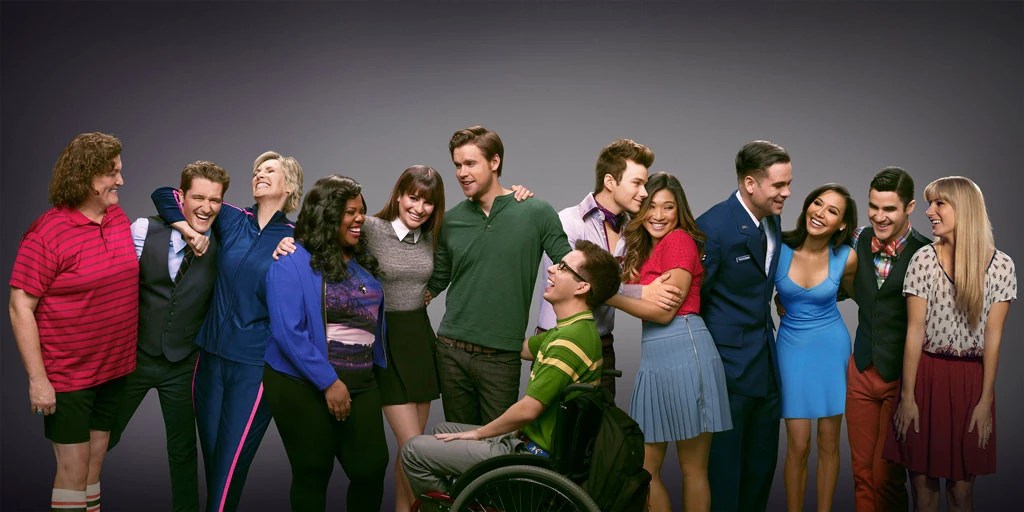
The show also applied this logic to its cast. Glee was a remarkably useful resource for not only bringing new talent to the forefront, but also in highlighting existing musical theatre talent to new audiences. While new talent like Chris Colfer, Dianna Agron, and Naya Rivera were showcased heavily across the show’s first few seasons; guest stars like Jonathan Groff, Idina Menzel, and Kristin Chenoweth in just the first season alone were thrust into the general public consciousness.
Speaking of Idina and Kristin, we’d be remiss not to mention Glee’s Season 1 cover of Defying Gravity, which featured Kurt and Rachel performing in a ‘diva-off’ (I (Jamie) made a note to not mention the butchered High F storyline but my god it makes me mad every single time I think about it) to see who would sing Wicked at Sectionals. It was a reimagining of the song, removing it from the context of the musical and giving it a pop feel, twisting its arrangement to become a mid-tempo piano ballad rather than a showstopping musical number. Lea Michele and Chris Colfer bodied their vocals, of course, and introduced a whole new audience to the wonderful world of Wicked. Kurt and Rachel would go on to perform For Good and Popular in later seasons (and why they didn’t tackle What is this Feeling in Season 1 is beyond me). Ryan Murphy was even tapped to direct the initial adaptation in the mid-2010’s. It feels justifiable to say that the success of Glee has at least contributed to the smash-hit success of 2024’s Wicked movie. If there was a pipeline discussing a series of events from Glee’s inception to Wicked scoring 10 Oscar nominations, it would make sense.
So, that’s the background. Where does that put Glee in our lives now?
It’s ten years since the end of Glee and we’ve since witnessed the death of teen television. The CW isn’t churning out its yearly dose of compelling, silly teen dramas anymore, even HBO Max has had its shot with reboots of Gossip Girl and Pretty Little Liars. It could be argued that teen television died out with its last bastion, Riverdale, a not-always-perfect but appropriately ridiculous entry into the teen drama canon. Since then, it’s…not been great. Perhaps it’s because the teens of today would rather scroll TikTok than get invested in a long-running television show, or maybe it’s because the language of trying to relate to that generation is in the hands of those who don’t relate to them.
All this to say, there wouldn’t even be room for something like Glee, and you certainly would not get six seasons out of it. A show getting six seasons nowadays is rare, and one that was as risky and non-conforming as Glee would have been shut down with haste. You wouldn’t get almost 750 cover versions and original songs on a soundtrack, let alone a world tour embarked upon by the cast and an accompanying concert movie. You wouldn’t get half the antics that ensued over the course of its run. It’s safe to say that Glee was a product of its era, for better or worse, and the nostalgia that’s felt even while writing this is strong.
When talking about why Glee was so successful, it’s hard not to mention its leader, Ryan Murphy. Brennan and Falchuck often get shafted here when discussing Glee’s conception because Murphy was the prevailing name that was brought up. Murphy was no stranger to long form television, being the creator of the hugely successful Nip/Tuck. His Emmy-winning work on Glee was the catalyst to where he is now, able to make anything that tickles his fancy – even when he perhaps shouldn’t. His deals with FX and Netflix have resulted in some fascinating work including the first two seasons of the anthology American Crime Story, and Scream Queens’ first season, but we’re hard pressed to actually recommend most of what he’s up to these days. Was Glee’s decline due to his multi-tasking and recommitment to American Horror Story? Potentially, but either way, it is Murphy that gets a lot of the flak for Glee’s tragic downfall.
As for the show’s stars…well, it’s a bit of a mixed bag! To all of their credits, they’ve used their star power to pursue the things that they wanted to, to varying degrees of success. Lea Michele attempted a pop solo career before realising that it wasn’t totally working out, and pivoted to a box-office smash replacement run in Rachel Berry’s dream role Funny Girl. It’s safe to say that Lea/Rachel parallel contributed to Funny Girl’s resurgence on Broadway – a decade later and Glee is still very much in the conversation.
To name a few others: Chris Colfer used his skyrocket to fame to take a backseat from acting and casually become a New York Times Bestseller with his children’s book series The Land of Stories. Though we’re thrilled for his success, we do desperately need his talent in front of the camera again please! Chord Overstreet and Amber Riley are among those who have committed to their music careers, though Overstreet currently stars on Apple TV+ series Acapulco while Riley had an Olivier Award-winning run in Dreamgirls – another production where her character sang multiple songs from the show on Glee. We’re sensing a pattern!
There have been entire (tasteless) documentaries made capitalising on this, but we do feel like we need to mention the tragic passings of Cory Monteith and Naya Rivera. As devastating as their losses were and still remain, Glee stands as an immortalisation for these actors and their immense talent, and a way for fans old and new to discover their work. So much has been said about ‘The Glee Curse’ but seeing it that way is reductive and gives no credit to the performers and people that were lost. We will remember Cory and Naya for their incredible performances as Finn and Santana and the love for them is felt in every behind-the-scenes interview and every moment since.
Throughout it all, Glee stuck the landing because its actors were lovable. Their talent and passion was raw, and drew us back every week, even when their character arcs were…messy.
Has this just been almost three thousand words just to say “Glee was good and people still talk about it”? Perhaps, but there’s something in that wherein we’re hard pressed to think of that many shows of its era that have left an equal imprint on pop culture. Pretty Little Liars? Eh, maybe, mostly thanks to Mike’s Mic’s iconic recaps and the multiple cast podcast episodes that have revealed much about the show that nobody knew. Other than perhaps that, it’s a struggle to recall something that so heavily dominated the culture at the time and continues to be a cornerstone for televisual representation, and perhaps the defining example of how a show can go from stellar to terrible in just a few short seasons.
Even with its ridiculous plot points, lack of commitment to character arcs, lazy writing, and bizarre choices at every turn, Glee is very much still a part of our lives, which is a testament to just how fantastic and iconic those first few seasons were. It helps that we were at an age where we sort of grew up with the characters and faced some of the same struggles and challenges as they did, but Glee’s showstopping first three seasons spoke for themselves.
Glee is a historical marker for progress in television and media. It is common knowledge that Glee addressed almost every single social issue, souring in many regards and missing the mark on many others. Much of it has not aged well – but that in itself is a testament to the work Glee did. It broke the ice on previously taboo topics for mainstream television, and paved the way for the evolution of the medium when audiences worldwide loved it. The core themes of the show would not have been greenlit even a few years before on such a large scale, and as we’ve already stated, would be unlikely to be greenlit now. Despite its falls, Glee was an actual, real lightning in a bottle turning point, that modern media today has used as a stepping stone toward bigger and better things.
Glee is good. And people still talk about it for good reason.
 the blueprint.